If you have lived in Colorado for a few years, you have probably noticed that your car seems to age faster here than it did back home. Paint fades, rubber seals crack, and headlights turn yellow faster than the manufacturer's warranty would suggest. It is not your imagination, and it is not bad luck. Colorado's environment is genuinely one of the most aggressive in the country for UV-sensitive materials, and headlight lenses take the full brunt of it.
Here is the full picture of why Denver and Colorado drivers deal with headlight oxidation faster than almost anywhere else in the United States.
The Altitude Factor: 25% More UV Than Sea Level
Denver sits at 5,280 feet above sea level. The atmosphere at that elevation is thinner, meaning there is less air mass to absorb and scatter incoming UV radiation before it reaches the ground. The general rule is that UV intensity increases by approximately 4% for every 1,000 feet of elevation gain.
Compared to a city at sea level, Denver receives roughly 20–25% more UV radiation on an average day. That might not sound dramatic, but compounded over 3–5 years of daily sun exposure on your vehicle, the difference is significant. A headlight lens that might stay clear for 7–8 years in a coastal city can be noticeably oxidized in 3–4 years in Denver.
In the mountain communities west of Denver, Evergreen, Conifer, Bailey, the effect is even more pronounced. At 7,000–8,000 feet, UV intensity is 30–35% higher than at sea level.
300+ Days of Sunshine: More Exposure Than Miami or Los Angeles
Colorado averages over 300 sunny days per year, more than either Miami or Los Angeles. This is one of the state's most celebrated qualities, but it also means your vehicle's exterior is under UV assault for the vast majority of the year.
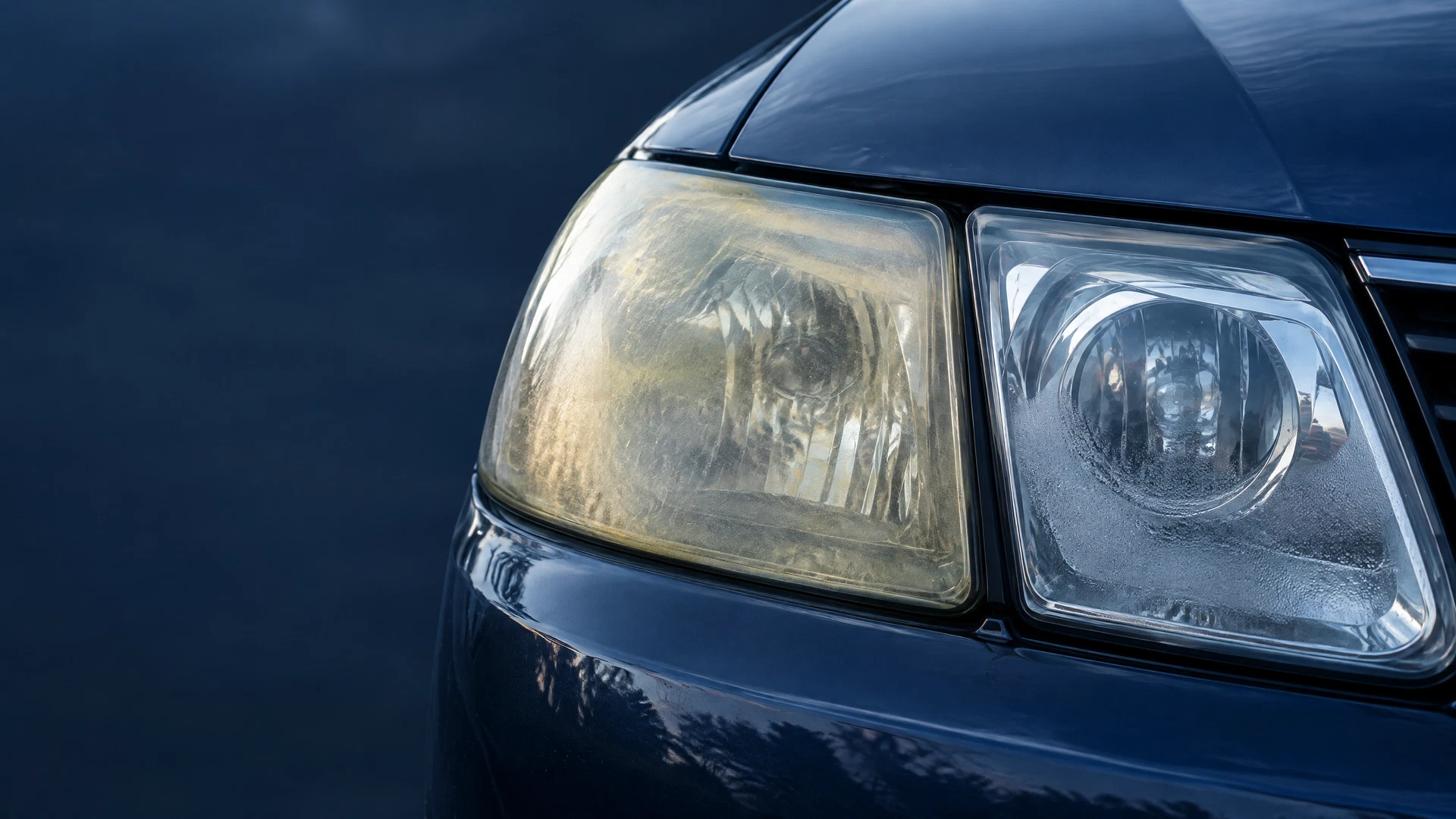
Headlight lenses are made from polycarbonate, a durable plastic that is inherently UV-sensitive. Manufacturers apply a thin UV-protective coating to the surface during production, but that coating is designed for average UV exposure, not Colorado's combination of high altitude and near-constant sunshine. It degrades faster here, and once it fails, the bare polycarbonate underneath oxidizes rapidly.
Winter Makes It Worse, Not Better
You might assume that Colorado's snowy winters would give your headlights a break from UV exposure. They do not. Fresh snow reflects up to 80% of incoming UV radiation, effectively doubling the UV dose hitting the front of your vehicle on a sunny winter day.
Add the road salt and sand that Colorado DOT applies to highways and city streets all winter, and you have a combination that accelerates both UV oxidation and surface scratching simultaneously. The abrasive sand blasted against your headlights at highway speeds creates micro-scratches that scatter light and compromise the UV coating, making the underlying polycarbonate more vulnerable to oxidation.
The I-25 and I-70 Effect
Denver's major highway corridors, I-25 running north-south and I-70 running east-west, see some of the highest sand and cinder application in the state during winter weather events. Vehicles that commute regularly on these corridors, particularly those driving into the sun during morning or evening rush hours, experience accelerated headlight degradation from both UV exposure and abrasive road debris.
If you commute east on I-70 in the morning or west in the evening, you are driving directly into the sun for extended periods. That direct sun exposure on the headlights, combined with highway-speed debris impact, is one of the most aggressive conditions a headlight lens can face.
What You Can Do About It
The most effective protection is a professional-grade UV ceramic coating applied over a freshly restored lens. This is what we apply at the end of every restoration job. The coating acts as a sacrificial UV barrier, absorbing the radiation instead of the polycarbonate underneath, keeping the lens clear for 2–3 years even in Colorado's environment.
If you want to handle maintenance yourself, choose a purpose-built lens prep and UV-protection system, and follow its instructions carefully. For significant oxidation, professional restoration remains the better starting point.
For vehicles already showing significant oxidation, a full professional restoration is the right starting point. Applying coating over an oxidized surface does not work, the surface needs to be properly prepared first.
The Denver Metro Reality
We restore headlights across the Denver Metro area every day, in Denver, Aurora, Lakewood, Arvada, Westminster, Centennial, Highlands Ranch, Littleton, Parker, Castle Rock, Thornton, Broomfield, Commerce City, and Wheat Ridge. The pattern is consistent: vehicles that are 4–6 years old often have headlights that look 10+ years old. It is not a quality issue with the vehicles. It is Colorado.
If your headlights are showing signs of UV damage, text us a photo at (720) 720-4910. We will give you an honest assessment and a quote, usually within the hour.